Good Food for Cities

Improving the competitiveness of banana production in Senegal

July 31, 2025

APROVAG, Association des PROducteurs de la VAllée fleuve de la Gambie, consists of 10 local farmer groups who depend on cultivating bananas for about 70% of their income. However, it’s a difficult for farmers to put aside part of their profits to save money, which in its turn complicates farmer families’ lives during the period when there is no banana harvesting. Since bananas are high in demand, farmers’ organisations find it hard to compete with Ivory Coast’s higher quality bananas.

Icon Place

Pays

Région

West Africa, Gambia River, south of the city of Tambacounda

Icon Scope

Objectif

Supporting Senegalese farmers' organisation through intensive coaching to target quality markets and to become a professional partner in the Senegalese and international banana business.

Icon Duration

Durée

2013-2019

Challenges

  • To increase productivity through better fertilization: There is still a shortage of sufficient organic fertilizers. This is why Rikolto is supporting the development of a compost company in Sankagne.
  • To irrigate more economically: One banana plant needs 50 to 60 litres of water per day. Most farmers water their plants only a few times a week, using a garden hose; a very intensive job. The diesel for the pumps is very expensive, which weakens the farmers’ competitive position.
  • To apply good agricultural practices: Each producer must fertilize, prune and thin out the plants (remove the small bananas so that other bananas can grow better) in the most effective way. All this has to be controlled, because the quality of a group sale is only as good as its weakest link. The quality control systems are not yet operational in every farmer group.
  • Organisation and planning of plantations: Anyone who supplies supermarkets has to meet strict legal standards. Everything has to be traceable. All data on when the plants are fertilized, watered and harvested has to be carefully collected in order to plan production. These registration systems have not yet been implemented either.
  • Quality, logistics and transport: What is the best way to pack bananas in boxes? What are the best boxes available on the Senegalese market? How do you make pallets and how do you organise transport from a plantation to Dakar? What forms do you need and what procedures have to be followed for export? APROVAG doesn't have any experience in these areas yet.
  • Transparent prices and contracts: What is the cost of certification and what additional income does this generate for the producers (as a result of being able to ask higher prices)? How do you draw up transparent contracts? A lot of the extra processing work (washing, packing, etc.) is done by women. What is a proper wage for this labour? The budget has yet to be clarified. APROVAG still has little experience in drawing up formal contracts on paper.
  • Certification: This summer, the farmer group Nguène II was granted organic and GLOBALG.A.P. certificates, and APROVAG/APROCOB was awarded Fair Trade certification. It remains a huge challenge to raise awareness among the other nine farmer groups and their members, and to set up the registration and control system that is necessary for organic and GLOBALG.A.P. certification (these are the requirements that farmers worldwide must meet with regard to food safety, sustainability and produce quality).
  • Transformation of APROVAG from association to company: APROVAG started out as a coordinating, subsidised association that looks after the interests of its affiliated members. APROVAG does very valuable political work, but this is sometimes difficult to reconcile with its commercial tasks. This is why the commercial arm APROCOB was founded. Nevertheless, it is a major challenge to get professional structures, procedures and attitudes accepted.
One of the biggest challenges facing organic bananas is production. The average yield for bananas is around 10 to 14 tonnes, compared with a potential yield of 40 to 60 tonnes. This underperformance is mainly due to a lack of good banana production practices and poor irrigation systems, which do not ensure that the plants are adequately watered.

Mambaye Sy

Organic Banana and Sesame Programme Manager in Senegal
Our approach

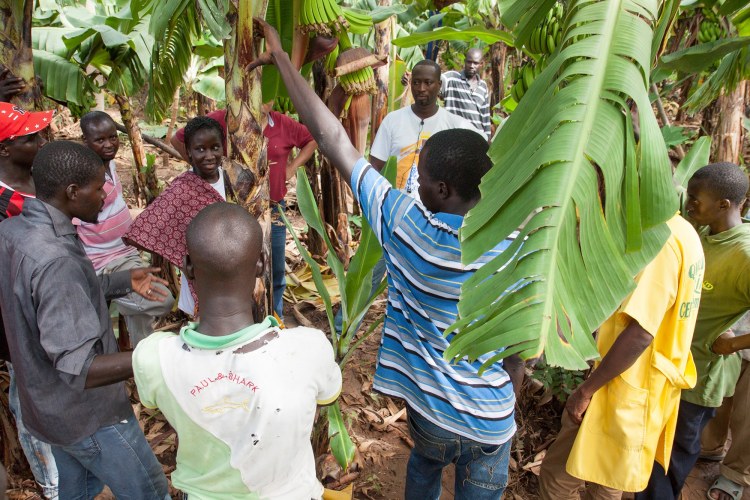
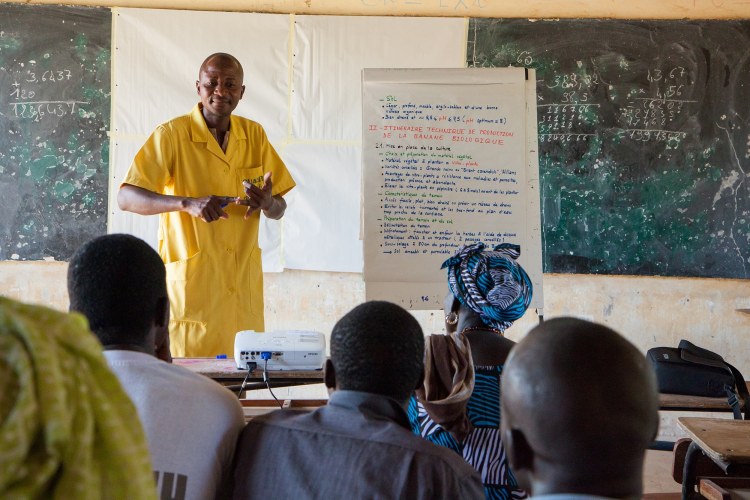
  • Agronomic support from APROVAG. This means that farmers are given advice about how to get the most out of their plantations. And, especially, how to improve the quality of their bananas, for instance by fertilizing in an appropriate way, by ‘pruning’ and by preventing certain pests.
  • Ensuring the production of organic fertilizer. In 2014 a small compost company was founded in Sankagne, which currently produces 45 tonnes of compost and creates jobs for 25 local young people. There is scope for expanding production. Furthermore, all members have to learn the best way to use organic fertilizer.
  • Investigating the best irrigation method for plantations; this includes experimenting with economical sprinklers that can water the banana plants more specifically and more frequently.
  • Investigating how banana farmers can best prepare to deal with climate change.
  • Intensively coaching farmer groups to obtain all the necessary certificates for the export market: Ecocert, Fair Trade and GLOBALG.A.P. At the moment, only one farmer group holds these certificates.
  • Rikolto is helping APROVAG and the farmers to set up the necessary registration, tracing and control systems to make export possible. This is just as necessary to be able to supply the quality markets of Dakar.
  • Seeking investment capital to build cableways from the field to the packing stations, etc.
  • Coaching APROCOB to become a profitable company. Optimizing financial, administrative and general business processes.

Achieved Results

  • In 2013, for the first time, APROVAG concluded two formal paper contracts with traders. Last year they sold a total of 2,373 tonnes of bananas.
  • To separate the commercial activities from the agronomic services that APROVAG renders to its members and the political work the organisation does, the company APROCOB was founded in 2014. This is the commercial arm of APROVAG.
  • There is one farmer group (Nguène II) that satisfies all the conditions and has obtained the organic and GLOBALG.A.P. certificates. The umbrella organisation APROVAG/APROCOB is now Fair Trade-certified.
  • In November 2014 a first experimental container of bananas was shipped off to give both APROVAG and the other players in the chain the opportunity to run through all the procedures. It went well. In the second shipment in November 2015 however, the bananas didn’t meet the necessary quality standards and couldn’t be sold for distribution in the supermarkets. The problems came from within the production process itself: water stress with the plants.

What do we expect in the long term?

  • About 9,000 farmers will be active in Senegalese banana production as a whole, and 85,000 people will indirectly live on the entire banana business. They will be united in UNAFIBS, the Union Nationale des Acteurs de la Filière Banane du Sénégal.

Figures

  • Beneficiaries: a total of 10 farmer groups in seven villages (531 members). Five farmer groups, with 434 members in total, are being coached intensively to enable them to target quality markets.
Dummy image

No items found.
Dummy image

Generation Food around the world

Generation Food is part of Rikolto's international program Food Smart Cities program. In various cities around the world, including Ouagadougou, Arusha, Arusha, Leuven, and Quito, Rikolto supports municipalities in formulating sustainable food policies and putting them into practice. In co-creation with universities, businesses, local food production/distribution initiatives, municipalities and farmers' cooperatives, we are developing business models (from farm to fork) that make the transition to sustainable cities possible. Through Generation Food, Rikolto advocates for the active participation of young people in the development of the future food system.

Read more

Who do we work with?

Agro Fair
Agro Fair
Colruyt Group
Colruyt Group
TASTE
Assistance technique pour le commerce durable et l'environnement
TASTE
APROVAG
Association des producteurs de la vallée du fleuve Gambie
APROVAG
DGD
Belgian development cooperation
DGD
Rikolto
Rikolto

Contact

Récits de terrain

Découvrez d'autres récits